How the World Wide Web began
In the late 1980s, the internet already existed in a loose technical sense, but it wasn’t something most people could easily use. Information lived on different computers, in different formats, and often required specialist knowledge just to access.
At the same time, Tim Berners-Lee was working at CERN, a huge international science research centre in Switzerland. Scientists from all over the world worked there, often for short periods, before heading back to their home countries.
That created a problem. Research papers, notes and documentation existed, but sharing them, or even knowing they existed, was frustratingly difficult.
So Berners-Lee set out to solve a very practical issue:
How can people, anywhere in the world, easily share and access information, no matter what computer they’re using?
Nothing flashy. Just a clear problem and a neat solution.
1989–1990: the building blocks
Between 1989 and 1990, that solution started to take shape around three simple ideas:
- HTML (HyperText Markup Language) – a way to structure information
- HTTP (Hypertext Transfer Protocol) – a standard way for computers to talk to each other
- Links – clickable text that takes you somewhere else of your choosing.
They don’t sound revolutionary now, because we use them every single day. But at the time, putting them together was the breakthrough.
This system became known as the World Wide Web.
That’s the background. Here’s the bit we really like…
1991: the first website goes live
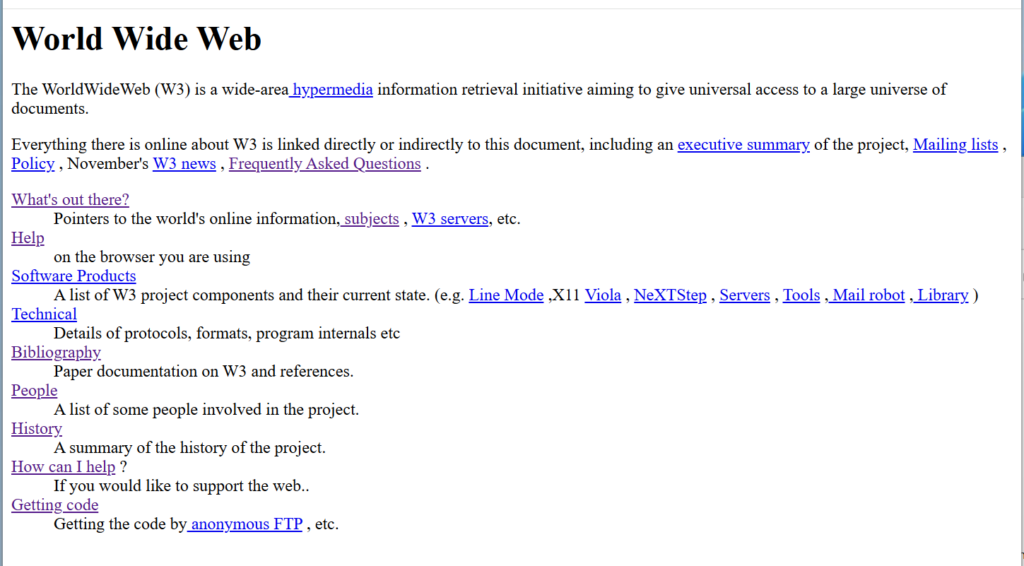
In 1991, the very first website went live - and it’s still online today (pretty cool!).
You can visit it at info.cern.ch

By modern standards, it looks almost empty. Plain text. Blue links. No images. No layout. No attempt to impress. And that’s exactly the point.
The page includes:
- What the World Wide Web actually is, it’s history and the people involved in the project
- How to set up a web server
- How to write a web page using HTML.
Each topic is laid out as simple text with links leading to the next piece of information. There’s no navigation menu, no visuals, and no hierarchy beyond the links.
It’s wonderfully basic, but it works - and it still works today for exactly the same reason.
The most brilliant part of all
The first website laid out what the World Wide Web was and how it worked, then showed others how to create their own pages using the same tools.
By doing that, it turned the web from a single experiment into something that could grow, one website at a time.
It did its job perfectly! That’s an astonishing starting point when you think about it.
Early 1990s: the web starts spreading
Once people followed those instructions, something amazing happened. More websites appeared. The web spread beyond CERN into universities, research centres and, before long, the wider public.
A crucial moment came when CERN made the web free and open - no licences, no fees, no ownership. Anyone could use it.
That decision is why the web grew so quickly and ended up becoming… well, everything.
Then vs now: what’s changed (and what hasn’t)
Modern websites look nothing like that first page. Today we expect images, video, responsive layouts, accessibility features, analytics, ecommerce, and entire content management systems running quietly behind the scenes.
But underneath all of that, the fundamentals are exactly the same.
Websites still rely on:
- Clear structure
- Pages connected by links
- Browsers requesting information from servers
- Content written for people to read.
The first website already had all of that. Everything else has simply been layered on top.
Still doing its job
The web has grown more complex, more visual and more powerful than anyone could have imagined in 1991.
But its foundation remains the same: clear information, shared openly, and meaningful connections.
The very first web page is still there, still working, and still doing exactly what it was made to do.
We think that’s pretty special.